I'm here to vent. I vent about plenty of other stuff: politics, government, ergonomics - well, that's pretty much it.
I got laid off yesterday. I didn't know if I was fired or laid off, until I got a call from my former employer about an hour after I was let go. She wasn't there when her husband went ahead and let me go, because she was getting her hair done, and he had an appointment to go to. She told me that she wanted to be there, bless her heart.
She also told me that this was "simply a business decision." She and her husband, one of the salespeople, had been looking at the business over the last few weeks, and that this decision just makes sense. She told me that I am a good employee and that I do great work. And she wished me luck. So probably fortunate for me, my "separation from employment"
status really was "laid off." (I love government speak. It's doubleplus ungood).
I had a feeling something like this was coming, because my former employer made a point a couple weeks ago of telling me that the two of them had been crunching some numbers. But when the layoff talk comes it's always a punch in the gut. And it was a nice touch when her husband told me he didn't want me to touch the computer when I was collecting my things from my office.
It seems quite easy to blame my most recent layoff on the reelection of President Obama. Hell, he got reelected 3 DAYS BEFORE they let me go. I could also blame the economy. I can just see and hear the words coming out of my former employer's husband's mouth after Romney conceded: "Well, Obama just got reelected. Time for plan B. We've gotta trim the fat. I know you want to do our own stuff, but we can send it out; it's cheaper. If they don't do it the way we want it, then we can just send it back; get 'em to fix it."
It is ironic, because my employer was not an Obama supporter. On the one
hand, she knows better than an Obama supporter that things are going to
get rough for small businesses, but on the other hand she knows that things
are going to get rough for employees (They might get benefits cut if they
have any. Hidden inflation might make their pay worth less. They might
be laid off. D'oh!).
To hell with all that, because I can wallow in an it's them not me game 'til I'm covered in shit. In the end, I will never know what really triggered my layoff.
First steps for the newly separated-from-employment subject: (1) I made my unemployment claim. Wait! Is that a claim, or do I apply for it - is it really insurance? (2) What next? (3) What is next.
NEXT IN SERIES: "Simply A Business Decision" 1.1
Saturday, November 10, 2012


Thursday, November 8, 2012
Take-Away Review: American Nations
American Nations: A History of the Eleven Rival Regional Cultures of North America by Colin Woodard
 I finished it. And it was a pretty good book, for me, since I finished it faster than I finish most books.
Colin Woodard definitely showed some of his prejudices - or at least his political slant, which is decidedly statist for most of the last quarter of the book. He criticized the "Dixie" block of nations for being against social welfare programs, environmental regulation, etc.
But Woodard did surprise at the end with a possible conclusion that I had considered for the future of our country. Our state might return to a loose federation or confederacy like it was under the Articles of Confederation of 1781. The central government would be limited to foreign policy, national defense, and negotiate interstate treaties. I don't know if that level of power would be low enough to satisfy me, or the component "nations" of a "reconstituted" state. But somethings gotta give.
The U.S. has a giant, bloated bureaucracy, giant, bloated redistribution and protectionist programs, a giant military that is deployed throughout the world, and no one wants or should pay for that unnecessary mess. I don't know if a revitalized regionalism expressed through resurgent "nations" would help fix the problem, because that might just transfer power from the federal government to the state governments. Also, the concept does not address personal freedom. But I do have a feeling that a weakened central government would do wonders for business, regional cooperation, and sovereign individualism.
 I finished it. And it was a pretty good book, for me, since I finished it faster than I finish most books.
Colin Woodard definitely showed some of his prejudices - or at least his political slant, which is decidedly statist for most of the last quarter of the book. He criticized the "Dixie" block of nations for being against social welfare programs, environmental regulation, etc.
But Woodard did surprise at the end with a possible conclusion that I had considered for the future of our country. Our state might return to a loose federation or confederacy like it was under the Articles of Confederation of 1781. The central government would be limited to foreign policy, national defense, and negotiate interstate treaties. I don't know if that level of power would be low enough to satisfy me, or the component "nations" of a "reconstituted" state. But somethings gotta give.
The U.S. has a giant, bloated bureaucracy, giant, bloated redistribution and protectionist programs, a giant military that is deployed throughout the world, and no one wants or should pay for that unnecessary mess. I don't know if a revitalized regionalism expressed through resurgent "nations" would help fix the problem, because that might just transfer power from the federal government to the state governments. Also, the concept does not address personal freedom. But I do have a feeling that a weakened central government would do wonders for business, regional cooperation, and sovereign individualism.
Tuesday, November 6, 2012
Federal Departments Stockpiling Ammo Like a Survivalist: 1.1
When I wrote about this before, I concluded that based on crunching numbers that I wasn't alarmed. But, well, I was never real comfortable with that. It is possible, that based on the sworn LEOs, and handicapping the Coast Guard to assume that all its personnel are war fighters, to conclude that the different federal agencies were procuring a reasonable amount of ammo. But it really is hard to believe that all of those gunmen and gunwomen are practicing and shooting at enough "bad guys" to utilize that much ammo. It is just logical to conclude that the federal government is stockpiling ammo for some reason.
And it is logical to conclude that those reasons could be (in no particular order) either-and-or-all-of-the-above: (1) The feds are expecting civil unrest based on fears of the revitalized freedom movement, which realizes that sovereignty is the individuals first. (2) The continued weakening of the economy, despite the feds fruitful attempts to conceal it, has made even the government's future ability to acquire supplies suspect. (3) The feds are competing in the marketplace with a revitalized civilian gun-owning population. (4) The weakening economy makes the possibility of food and employment rioting a distinct possibility. (5) The Oath Keepers, with their commitment to the Constitution, and their employment with local, state, and federal law-enforcement and military entities, are a direct threat to federal power within government. (6) Because of the current economic downturn, the feds plan to enforce nationalization of sectors of the economy through force. (7) The states are decriminalizing victimless behavior, making it less likely that the states will participate in the enforcement of federal victimless crimes (e.g. marijuana, which is already compelling the feds to make raids in California). (8) State and local officials are protecting citizens against federal enforcement of laws and regulations that threaten the lives of citizens (e.g. sheriffs threatening to arrest fed agents that would enforce rules against landowners creating firebreaks on federal land).
I've been mulling this issue over for quite sometime. Like Bob Mayne, on The Handgun World Show has said, I don't want to be a tinfoil-hat kind of guy, but there is something afoot. And I am not the only one still talking about this:
So, Why did the DHS Buy all that Ammo? by Brad Kozak on Guns.com is an interesting read.
Whatever's going on, I am vigorously attempting to keep my tinfoil hat away from my head. But I've still got my finger to the wind.
Previous In Series: Federal Departments Stockpiling Ammo Like A Survivalist: 1.0
And it is logical to conclude that those reasons could be (in no particular order) either-and-or-all-of-the-above: (1) The feds are expecting civil unrest based on fears of the revitalized freedom movement, which realizes that sovereignty is the individuals first. (2) The continued weakening of the economy, despite the feds fruitful attempts to conceal it, has made even the government's future ability to acquire supplies suspect. (3) The feds are competing in the marketplace with a revitalized civilian gun-owning population. (4) The weakening economy makes the possibility of food and employment rioting a distinct possibility. (5) The Oath Keepers, with their commitment to the Constitution, and their employment with local, state, and federal law-enforcement and military entities, are a direct threat to federal power within government. (6) Because of the current economic downturn, the feds plan to enforce nationalization of sectors of the economy through force. (7) The states are decriminalizing victimless behavior, making it less likely that the states will participate in the enforcement of federal victimless crimes (e.g. marijuana, which is already compelling the feds to make raids in California). (8) State and local officials are protecting citizens against federal enforcement of laws and regulations that threaten the lives of citizens (e.g. sheriffs threatening to arrest fed agents that would enforce rules against landowners creating firebreaks on federal land).
I've been mulling this issue over for quite sometime. Like Bob Mayne, on The Handgun World Show has said, I don't want to be a tinfoil-hat kind of guy, but there is something afoot. And I am not the only one still talking about this:
So, Why did the DHS Buy all that Ammo? by Brad Kozak on Guns.com is an interesting read.
The Federal government never communicated why they need this much ammo, and what they plan to do with it. We are waiting on answers. Are they “keeping us safe” by arming the Social Security Administration and the National Weather Service? I find that hard to believe. But I can believe that they are worried about riots and armed revolts. Because DHS is tasked with keeping the homeland safe, I wonder if this is how they plan to go about it.Personally, I think the DHS distributed, on paper, ammo to the less belligerent agencies in order to do two things: (1) to feebly conceal the true purpose of the ammo, and (2) to easily distribute it to multiple locations throughout the country.
Whatever's going on, I am vigorously attempting to keep my tinfoil hat away from my head. But I've still got my finger to the wind.
Previous In Series: Federal Departments Stockpiling Ammo Like A Survivalist: 1.0
Monday, November 5, 2012
Obama is Our Governor
The term governor - used as the title for the political leader of each individual state within our United States - is an anachronism. It is a left over from the British colonial epoch, when Great Britain appointed governors to rule over its colonies. Australia still has a Governor-General and Canada still has a Governor General.
With the current state of state rights and individual rights, it seems appropriate that the states choose a different title for their chief executives, since the governors don't represent a foreign power but lead the states themselves - and they haven't since our country kicked Great Britain out. President sounds good.
And with the current state of federal power, it seems appropriate to change the title of the chief executive of the federal government of the United States. Though our federal government is not technically a foreign power, it is becoming more distant from the individuals and states, it is creating its own federally-employed class with a ridiculous disparity of compensation compared to the private sector, and it is picking us off one by one with victimless-"crime" laws. The title president no longer adequately describes the federal government's chief executive. Governor sounds good.
Either way, I hope I don't wake up to four more years of Governor Obama or President Obama on November 7.
With the current state of state rights and individual rights, it seems appropriate that the states choose a different title for their chief executives, since the governors don't represent a foreign power but lead the states themselves - and they haven't since our country kicked Great Britain out. President sounds good.
And with the current state of federal power, it seems appropriate to change the title of the chief executive of the federal government of the United States. Though our federal government is not technically a foreign power, it is becoming more distant from the individuals and states, it is creating its own federally-employed class with a ridiculous disparity of compensation compared to the private sector, and it is picking us off one by one with victimless-"crime" laws. The title president no longer adequately describes the federal government's chief executive. Governor sounds good.
Either way, I hope I don't wake up to four more years of Governor Obama or President Obama on November 7.
Thursday, October 25, 2012
Are You A First Responder?
Damn straight you are. If you're there when the shit hits the fan, then "you're up." Are you ready?
I'm not. Rusty on CPR. Etc.
I'm not. Rusty on CPR. Etc.
Wednesday, October 24, 2012
Preliminary Book Review: American Nations
American Nations: A History of the Eleven Rival Regional Cultures of North America by Colin Woodard
Less than half way through. Eye opening. The character of our nation (and the nations of Mexico and Canada) is deceptively simple, if you only look at state lines and stereotypical regions. Of course, this coming from someone that did not know that his dad grew up in Appalachia (I thought southeastern Ohio had character enough).
So far, I identify the most the "Greater Appalachia," which I happen to live in.
I've read - a couple times - The Nine Nations of North America by Joel Garreau. It was a great read, but it was a snapshot of the area set - by default - in the late 1970s. Colin Woodard was right that the historical context of these "nations" is so informative, and that is what makes (so far) American Nations so compelling.
Less than half way through. Eye opening. The character of our nation (and the nations of Mexico and Canada) is deceptively simple, if you only look at state lines and stereotypical regions. Of course, this coming from someone that did not know that his dad grew up in Appalachia (I thought southeastern Ohio had character enough). So far, I identify the most the "Greater Appalachia," which I happen to live in.
I've read - a couple times - The Nine Nations of North America by Joel Garreau. It was a great read, but it was a snapshot of the area set - by default - in the late 1970s. Colin Woodard was right that the historical context of these "nations" is so informative, and that is what makes (so far) American Nations so compelling.
Sunday, October 21, 2012
Freedom versus Liberty
I've described myself as a libertarian, classical liberal, even an anarcho-capitalist. All those terms seem defined by their context. Even taking anarcho-capitalist to its core, its larger category of anarchist leaves one defined by a context and not what is inherent to the person. Anarchy literally means "without a ruler." (Wikipedia.org)
The concept of liberty is lacking. It sounds like you are being allowed to do something. Freedom seems more universal, less defined by a person's environment - more inherent. I've been frustrated by a lack of analysis or dialogue until I found this:
Being on the freedom end of the political spectrum leaves one, as a matter of convenience, defined a libertarian or anarchist, or possibly a sovereign individualist. Is there a label or philosophy that is more concrete? Freedomer? Freedom lover? Well, the philosophy is freedom. That's simple. But what do you call the adherent? Freeman? Freewoman? Freeone? Freeneck? Freedomer?
The concept of liberty is lacking. It sounds like you are being allowed to do something. Freedom seems more universal, less defined by a person's environment - more inherent. I've been frustrated by a lack of analysis or dialogue until I found this:
One might ask how [the] tyrannical society [of the indenture-servitude and slavery based mid-Atlantic] could have produced some of the greatest champions of republicanism, such as Thomas Jefferson, George Washington, and James Madison. The answer is that Tidewater's gentry embraced classical republicanism, meaning a republic modeled after those of ancient Greece and Rome. They emulated the learned, slave-holding elite of ancient Athens, basing their enlightened political philosophies around the ancient Latin concept of libertas, or liberty. This was a fundamentally different notion from the Germanic concept of Freiheit, or freedom, which informed the political thought of Yankeedom [New England] and the Midlands. Understanding the distinction is essential to comprehending the fundamental disagreements that still plague relations between Tidewater [mid-Atlantic], the Deep South, and New Spain on one hand and Yankeedom and the Midlands on the other.
American Nations: A History of the Eleven Rival Regional Cultures of North American by Colin WoodardAnd of course, once my mind was more open to the conflict, I ran across this: "Freedom vs. Liberty" by Joseph R. Stromberg on LewRockwell.com. This article goes into the etymology of the two terms. And Stromberg comes to a similar conclusion that I did, that "'freedom' seems a bit more world-bound or concrete than 'liberty.'"
Being on the freedom end of the political spectrum leaves one, as a matter of convenience, defined a libertarian or anarchist, or possibly a sovereign individualist. Is there a label or philosophy that is more concrete? Freedomer? Freedom lover? Well, the philosophy is freedom. That's simple. But what do you call the adherent? Freeman? Freewoman? Freeone? Freeneck? Freedomer?
Thursday, October 11, 2012
Hi-Point Challenge: Weeks 3 & 4
Frankly, I had lost some interest in this one. Maybe because I don't need to go out and buy a Hi-Point tomorrow. Week 3 didn't add much to my interest.
The Hi-Point Challenge: Week3 on GunNutsMedia.
But Week 4, Tim got a donated custom Kydex holster. I've read about homemade Kydex holsters. Let's see - USACarry.com Homemade Hybrid Holster Forum Thread.
The Hi-Point Challenge: Week 4 on GunNutsMedia.
The Hi-Point Challenge: Week3 on GunNutsMedia.
But Week 4, Tim got a donated custom Kydex holster. I've read about homemade Kydex holsters. Let's see - USACarry.com Homemade Hybrid Holster Forum Thread.
The Hi-Point Challenge: Week 4 on GunNutsMedia.
Looking for a DAO Auto (Seriously!). Found SIG P250, Again.
The single-action on my Ruger P95 is troublesome. Since, even with a Bell grip sleeve, I still have trouble maintaining my grip, especially, I've recently realized, when my pistol goes single action. Well, I've considered a stronger spring, but I don't know if it would just destroy the feel of the double-action trigger. I like a double-action trigger, for carry, and I can deal with the transition if it doesn't affect my grip. And holding my finger on the trigger shouldn't be part of my grip.
Well, I'm not giving up on the P95 - just interested in alternatives.
And why not have a consistent trigger? Almost all striker-fired pistols have them, so why not one of them? Well, I still like having a pistol sitting in a holster with a long trigger pull, since I don't want to depend on a safety. Like Gaston Glock found through research, safeties cause accidental discharges, because the user has to know what condition the gun is in - cocked, decocked, on safe (Glock: The Rise of America's Gun, Paul M. Barrett). Well, I'm back to wanting a long trigger for carry. Revolvers are great for that, but I like semi autos too, so ...
Used to, there seemed to be more choices for real DAOs. Ruger made a DAO P95. Some say it was done just as special order items for government agencies like the Federal Bureau of Prisons, but I don't remember it that way. And there were Smith & Wessons. They seemed to be a compromise in the transition from revolvers to semi autos for police departments; a transition that was largely trumped by the entrance of Glock into the U.S. police-weapons market.
I'm interested in Kahrs - might end up with a CW9 or CW40 - but they are not true DAOs. Movement of the slide initiates the cocking of the striker, and pulling trigger finishes the cocking. That is something that, if I am correct, Glock does too, but with a single-action like trigger feel.
So, where are the true DAO autos, now? Beretta makes the Nano. And SIG makes DAK (short-reset, double-action) pistols. I'm interested in the Nano.
But there is something about the SIG P250. Maybe it's that modular thing, which the Nano has too, but the P250 seems to have more of it. "Gun Review: SIG SAUER P250 9mm 2SUM" on TheTruthAboutGuns.com.
And this a great review of the SIG P250 from a confessed SIG fan.
So what does this all come from and lead to?
Well, I already was interested in the P250 SUM2 truly modular concept. But now I'm interested in the plain old true DAO trigger, where that was a deal breaker in the past.
Also, in a round about way, the search for info about the SIG P250 led me to the Gun Guys Radio podcast - a truly listen-worthy podcast. And it gave a me a chance to put a smile on someones face. If you want to find out how, then listen at 1:12:55 of their 031 GGR – Cowboy Up! with Evil Roy & Randi Rogers episode.
Well, I'm not giving up on the P95 - just interested in alternatives.
And why not have a consistent trigger? Almost all striker-fired pistols have them, so why not one of them? Well, I still like having a pistol sitting in a holster with a long trigger pull, since I don't want to depend on a safety. Like Gaston Glock found through research, safeties cause accidental discharges, because the user has to know what condition the gun is in - cocked, decocked, on safe (Glock: The Rise of America's Gun, Paul M. Barrett). Well, I'm back to wanting a long trigger for carry. Revolvers are great for that, but I like semi autos too, so ...
Used to, there seemed to be more choices for real DAOs. Ruger made a DAO P95. Some say it was done just as special order items for government agencies like the Federal Bureau of Prisons, but I don't remember it that way. And there were Smith & Wessons. They seemed to be a compromise in the transition from revolvers to semi autos for police departments; a transition that was largely trumped by the entrance of Glock into the U.S. police-weapons market.
I'm interested in Kahrs - might end up with a CW9 or CW40 - but they are not true DAOs. Movement of the slide initiates the cocking of the striker, and pulling trigger finishes the cocking. That is something that, if I am correct, Glock does too, but with a single-action like trigger feel.
So, where are the true DAO autos, now? Beretta makes the Nano. And SIG makes DAK (short-reset, double-action) pistols. I'm interested in the Nano.
 | |
| Nano - BerettaUSA.com |
 |
| CW40 - Kahr.com |
But there is something about the SIG P250. Maybe it's that modular thing, which the Nano has too, but the P250 seems to have more of it. "Gun Review: SIG SAUER P250 9mm 2SUM" on TheTruthAboutGuns.com.
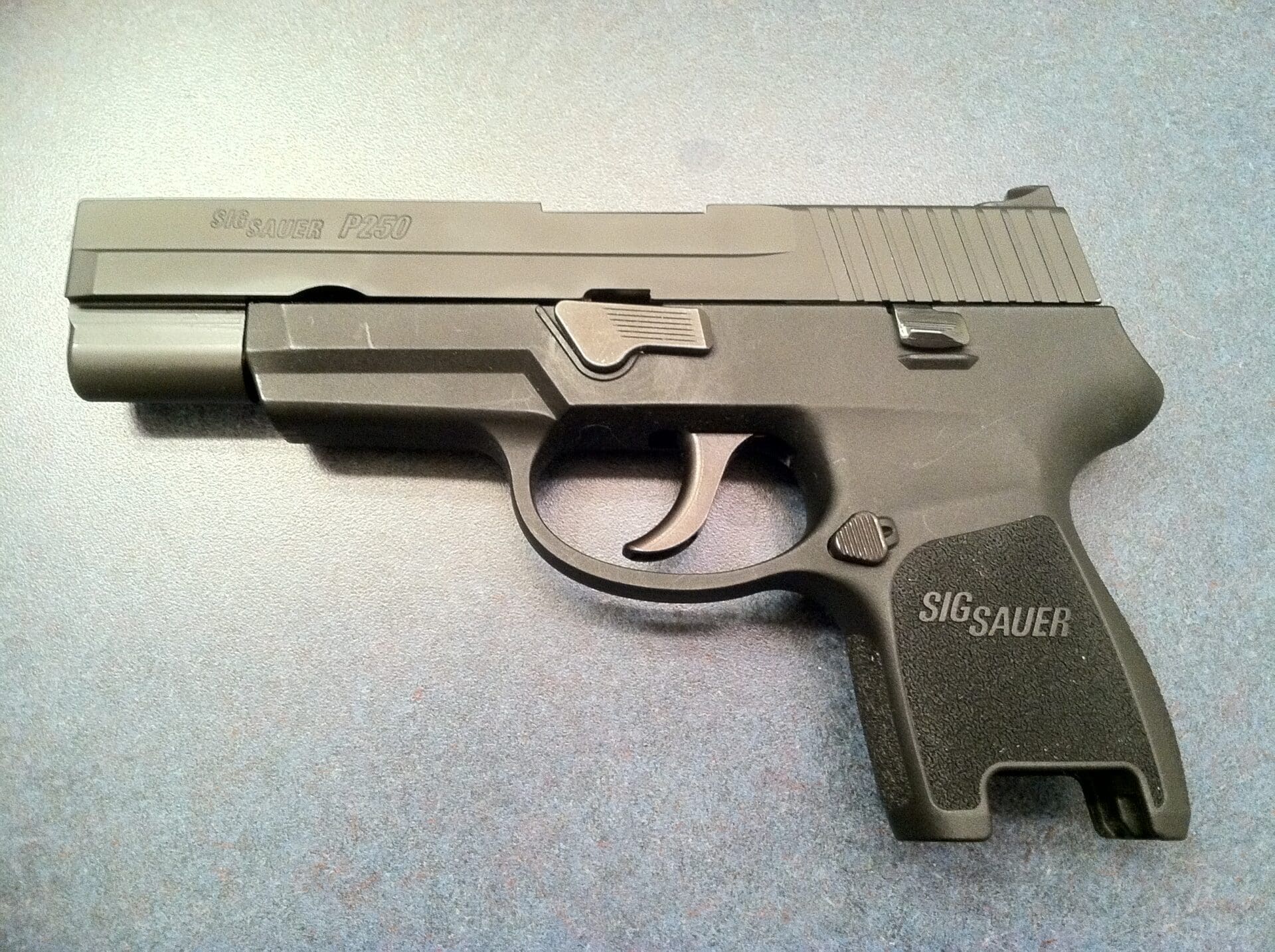 |
| TheTruthAboutGuns |
So what does this all come from and lead to?
Well, I already was interested in the P250 SUM2 truly modular concept. But now I'm interested in the plain old true DAO trigger, where that was a deal breaker in the past.
Also, in a round about way, the search for info about the SIG P250 led me to the Gun Guys Radio podcast - a truly listen-worthy podcast. And it gave a me a chance to put a smile on someones face. If you want to find out how, then listen at 1:12:55 of their 031 GGR – Cowboy Up! with Evil Roy & Randi Rogers episode.
Tuesday, October 2, 2012
Ruger P95: Tauted As Quality Budget Gun, Again
Once again, the Ruger P95 is recommended as a quality budget gun - this time by Guns & Ammo. Guns & Ammo's 8 Quality Carry Guns for Under $400

Yes, I own one, so I am happy about its inclusion in Guns & Ammo's list. But as an out of the box carry gun, or duty gun, I think, depending on your hand-size, that one of the other suggestions would do you better. If you can grab it with a vice-like grip and still pull the trigger, then you're good to go. If you can splurge for a bicycle-inner-tube grip sleeve, then you're good to go. But if you don't want to fiddle, or actually do modifications, then possibly you should look further.
The S&W SD40 and FMK 9C1 seem to have a leg up on the Ruger P95 as far as grip ergonomics go. I've heard crappy things about the S&W SD-series' crappy trigger, but I've never shot it. I haven't heard a thing about the FMK 9C1. So I want to try both of them.

Yes, I own one, so I am happy about its inclusion in Guns & Ammo's list. But as an out of the box carry gun, or duty gun, I think, depending on your hand-size, that one of the other suggestions would do you better. If you can grab it with a vice-like grip and still pull the trigger, then you're good to go. If you can splurge for a bicycle-inner-tube grip sleeve, then you're good to go. But if you don't want to fiddle, or actually do modifications, then possibly you should look further.
The S&W SD40 and FMK 9C1 seem to have a leg up on the Ruger P95 as far as grip ergonomics go. I've heard crappy things about the S&W SD-series' crappy trigger, but I've never shot it. I haven't heard a thing about the FMK 9C1. So I want to try both of them.
Subscribe to:
Posts (Atom)
Clicky.com

